Importance of Yarn Uster Testing
Yarn quality is the backbone of the textile industry. No matter how good the fabric design is, poor yarn quality will always create problems in weaving, knitting, dyeing, and finishing.
That is why Yarn USTER Testing is considered one of the most important quality control tests in the spinning and textile industry.
In Pakistan, yarn is not only used locally but also exported to international buyers. These buyers expect consistent, measurable, and internationally comparable quality results. USTER testing provides exactly that.
This guide explains Yarn USTER Testing in detail — what it is, why it is important, how it is performed, what parameters are measured, and how manufacturers and buyers use these results for decision-making.
What Is Yarn USTER Testing?
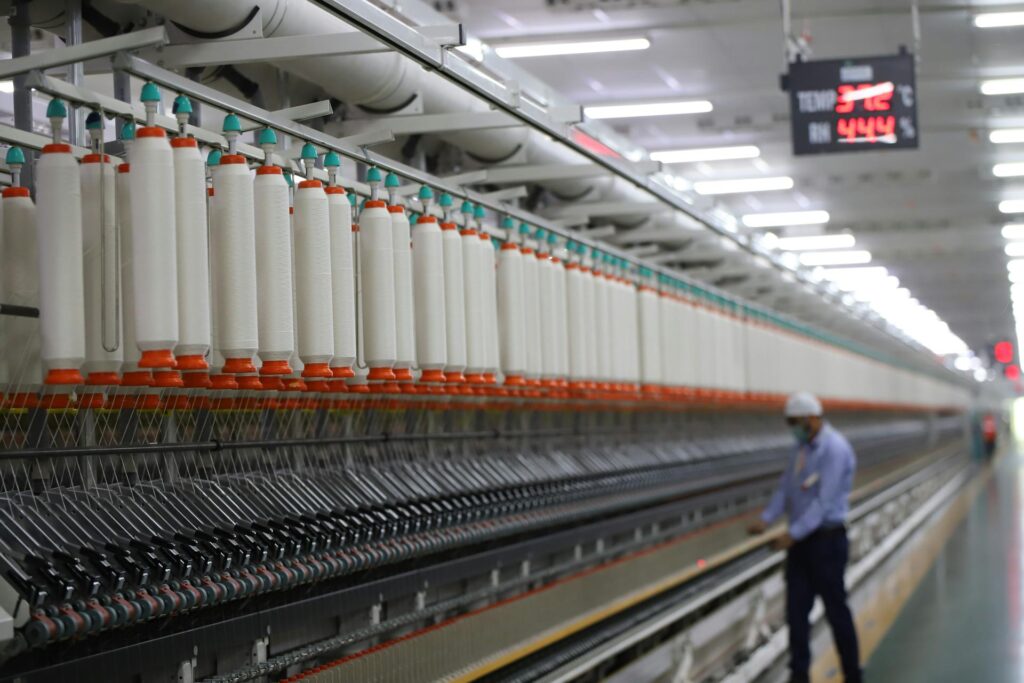
Yarn USTER Testing is a laboratory-based evaluation of yarn evenness and quality using USTER instruments.
USTER testing measures variations, imperfections, and defects in yarn that cannot be judged accurately by visual inspection alone.
It provides numerical values that help spinning mills, fabric manufacturers, and buyers:
- Compare yarn quality
- Control production consistency
- Reduce fabric defects
- Meet buyer specifications
USTER results are globally recognized and accepted.
Why Yarn USTER Testing Is Important
Consistency in production
Yarn may look fine to the naked eye, but even small variations in thickness or structure can cause serious problems during weaving or knitting. USTER testing identifies these variations early.
Buyer confidence
International buyers often request USTER Test Reports before approving yarn suppliers. These reports give buyers confidence that yarn quality meets global benchmarks.
Process improvement
Spinning mills use USTER results to identify problems in carding, drawing, roving, or spinning processes and improve efficiency.
Key Yarn Properties Measured in USTER Testing
USTER testing focuses on yarn uniformity and fault distribution. The main parameters are explained below in simple terms.
Yarn Evenness (U%)
Evenness shows how uniform the yarn thickness is along its length.
- Lower U% = better yarn quality
- Higher U% = more variation
Even yarn leads to smoother fabric and fewer defects.
Coefficient of Variation (CV%)
CV% shows the degree of mass variation in yarn.
It is another way of expressing yarn uniformity and is widely used by buyers for comparison between suppliers.
Thin Places (-50%)
Thin places are sections where the yarn is significantly thinner than average.
Too many thin places can cause:
- Yarn breakage
- Weak fabric areas
Thick Places (+50%)
Thick places are yarn sections thicker than normal.
They may lead to:
- Fabric streaks
- Uneven dyeing
- Poor appearance
Neps (+200%)
Neps are small knots or entangled fiber clusters.
High nep count results in:
- Speckled fabric appearance
- Dye spots
- Poor fabric aesthetics
Hairiness Index
Hairiness measures how many fibers protrude from the yarn surface.
Excessive hairiness can cause:
- Lint formation
- Machine stoppages
- Poor fabric handle
USTER Statistics – Global Comparison Tool
One of the strongest features of USTER testing is USTER Statistics.
USTER Statistics allow yarn results to be compared with global spinning mill performance.
For example:
| USTER Percentile | Meaning |
|---|---|
| 5% | World-class quality |
| 25% | Very good quality |
| 50% | Average quality |
| 75% | Below average |
| 95% | Poor quality |
Lower percentile values indicate better yarn quality.
Buyers often specify maximum USTER percentile limits in their contracts.
USTER Testing Equipment
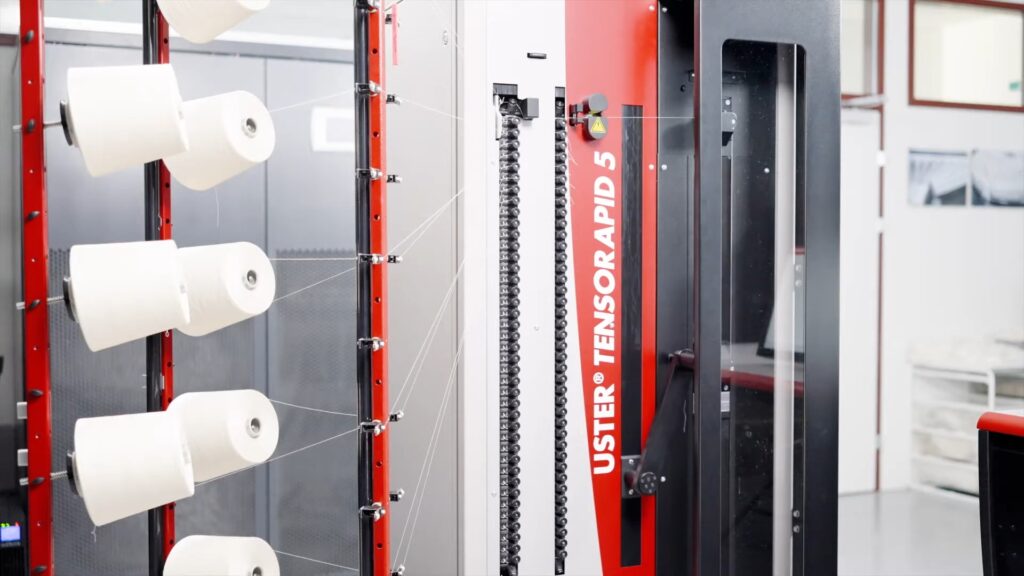
Yarn USTER testing is performed using specialized instruments such as:
- USTER Tester (Evenness Tester)
- USTER Quantum (Imperfection Analyzer)
- USTER Hairiness Tester
These machines provide fast, accurate, and repeatable results.
Step-by-Step Yarn USTER Testing Procedure
Sample selection
Representative yarn samples are taken from production. Proper sampling is critical because poor sampling can lead to misleading results.
Conditioning
Yarn samples are conditioned under standard temperature and humidity to ensure accurate measurements.
Testing process
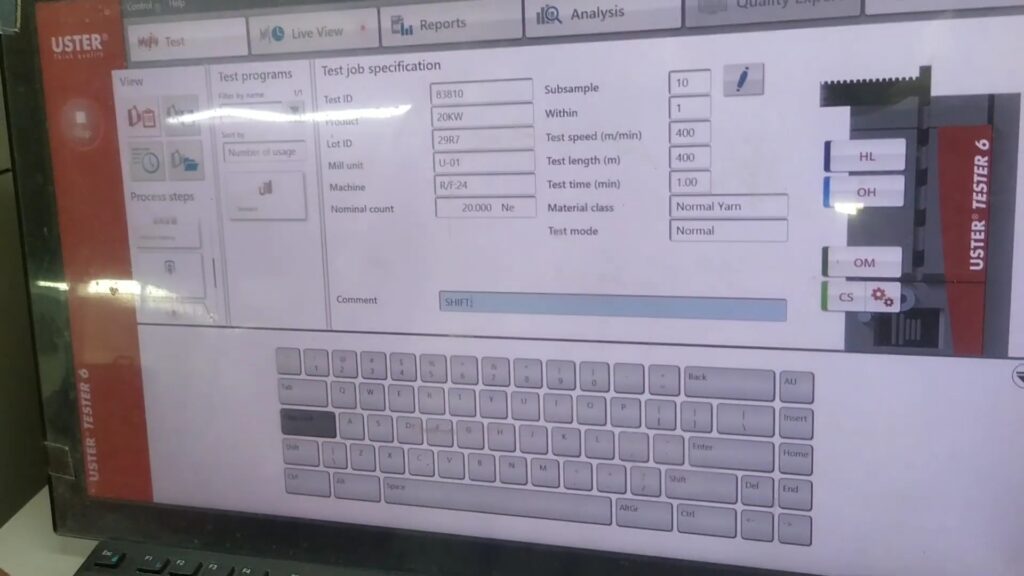
The yarn passes through USTER sensors at controlled speed. The instrument continuously measures mass variation, imperfections, and hairiness.
Data analysis
Results are generated automatically and compared with USTER Statistics.
Report generation
A detailed test report is issued showing numerical values, graphs, and percentile rankings.
Precautions Before Yarn USTER Testing
To ensure reliable results:
- Use representative production samples
- Avoid contaminated or damaged yarn
- Maintain proper environmental conditions
- Follow correct sampling length and count
These steps help avoid disputes with buyers later.
Applications of Yarn USTER Test Results
USTER results are used by:
- Spinning mills for quality control
- Weaving and knitting units for yarn selection
- Exporters for buyer approval
- Quality auditors during inspections
Good USTER results reduce fabric defects, rejections, and production losses.
Turnaround Time
Typical turnaround time for Yarn USTER Testing is 1 to 3 working days, depending on sample quantity and parameters tested.
Why Choose SAB Labs for Yarn USTER Testin
SAB Labs provides professional yarn testing services using internationally recognized methods and equipment.
The laboratory supports manufacturers, exporters, and buyers by delivering accurate results, clear reporting, and technical guidance for quality improvement.
Final Conclusion
Yarn USTER Testing is not just a laboratory test. It is a decision-making tool for the entire textile value chain.
From spinning to fabric production and export, USTER testing ensures consistency, reliability, and international acceptance of yarn quality.
For Pakistan’s textile industry, proper USTER testing is essential to remain competitive in global markets.