Skip to content
Faux leather fabric is a synthetic material made from a woven or knit base fabric coated with polyurethane (PU) or polyvinyl chloride (PVC) to copy the look and feel of real leather. Faux leather offers a lower cost, a cruelty-free source and easier cleaning than natural leather, along with consistent colour and thickness across a full roll. Manufacturers use faux leather for footwear, bags, garments, furniture, automotive interiors and industrial products where a leather-like surface matters more than natural hide performance.
This guide covers what faux leather contains, how factories make it, its main properties, its main types, how it compares with real leather, common defects, lab tests, standards and certifications such as ISO, ASTM, OEKO-TEX, REACH and RoHS, and faux leather testing support in Karachi, Lahore and across Pakistan through SAB Labs.
What Is Faux Leather Fabric?
Faux leather fabric is a synthetic material that copies the look, feel and function of real leather through a fabric base coated with polyurethane (PU) or polyvinyl chloride (PVC). People also call this material pleather, vegan leather, synthetic leather, artificial leather, fake leather or ersatz leather. Faux leather contains no animal hide. Manufacturers make it entirely from petroleum-based plastics or, in newer versions, partly from vegetable oils. This material offers a water-resistant surface, an even colour and a lower cost than genuine leather, which makes it a common substitute in fashion, furniture and industrial products.
What Is Faux Leather Made Of?
Faux leather consists of 4 main components: a base fabric, a PU or PVC coating, additives and pigments, and a finishing layer.
Base Fabric
The base fabric gives faux leather its strength and structure. Manufacturers most often use cotton or polyester for this layer. This fabric arrives in a woven or knit form with a rough, porous surface, which allows the coating to bond to it during production. A tighter, more even weave in the base fabric produces a smoother, more durable finished material.
PU Coating
Polyurethane (PU) coating gives faux leather a soft handfeel, good flexibility and a thinner overall profile than PVC. Manufacturers apply this coating in a liquid form and cure it with heat, which bonds it to the base fabric. PU leather bends easily and resists cracking better than PVC leather in cold temperatures. This coating costs more to produce than PVC.
PVC Coating
Polyvinyl chloride (PVC) coating gives faux leather a thicker, glossier and more water-resistant surface than PU. Manufacturers combine chlorine, derived from salt, with ethylene, derived from petroleum, to form ethylene dichloride, then convert this into vinyl chloride monomer and finally into polyvinyl chloride resin. Manufacturers add plasticizers to this resin, which make the stiff PVC flexible enough to bond onto a base fabric.
Additives, Pigments and Finishing Chemicals
Additives, pigments and finishing chemicals give faux leather its colour, surface texture and performance properties. Pigments set the base colour before manufacturers emboss or print a grain pattern onto the coating. Isocyanates and polyols react together during PU formulation, while stabilisers and flame retardants improve the finished material’s resistance to heat and UV light.
History of Faux Leather Fabric
Faux leather traces back to attempts by Chinese manufacturers in the 15th century to coat fabric with oils and resins. These early efforts never reached large-scale production. Mass production of faux leather became possible only after the development of petroleum-based plastics at the end of the 19th century. German manufacturers created one of the first commercial faux leathers, called Presstoff, from treated paper pulp during a period of leather shortages. This material fell apart in wet conditions and never gained wide use outside Germany.
The United States Rubber Company, founded in 1892, introduced Naugahyde in 1920 as a vinyl-coated fabric, first used for handbags. Naugahyde grew into a common material for furniture, luggage and industrial products through the 1930s, and the U.S. Armed Forces later adopted it for military equipment. Naugahyde stayed the best-known name in synthetic leather for decades. Newer PU and PVC formulations from other manufacturers took a larger share of the market from the 1950s onward.
How Is Faux Leather Fabric Made?
Faux leather fabric goes through 6 main production stages: preparing the base material, formulating the coating, applying the coating, embossing the texture, colouring and finishing, and cutting and inspection.
Preparing the Base Material
Manufacturers prepare a base fabric, most often cotton or polyester, by cleaning and stretching it flat before coating. This fabric needs a rough, even surface. A smooth or uneven weave stops the coating from bonding correctly. Most faux leather producers buy pre-woven base fabric from separate textile mills rather than weave it themselves.
Formulating the PU or PVC Coating
Manufacturers formulate polyurethane (PU) from isocyanates and polyols, or polyvinyl chloride (PVC) from chlorine and ethylene-based compounds converted into resin. Manufacturers mix plasticizers, stabilisers and pigments into either formulation to control flexibility, durability and colour. This stage sets the final coating’s thickness, softness and resistance to heat and cracking.
Applying the Coating to the Fabric
Manufacturers apply the liquid PU or PVC coating onto the base fabric using a roller, knife or transfer-coating method, then cure it with heat to bond the two layers together. This stage controls the final material’s thickness and determines how well the coating resists peeling later. A consistent coating weight across the full roll keeps thickness even from edge to edge.
Embossing the Leather-Like Texture
Manufacturers press a heated, textured roller or plate onto the coated fabric to create a leather-like grain pattern. This stage sets the surface pattern, such as a pebbled, pull-up or smooth finish, before the material cools and sets. A deeper, more irregular embossing pattern helps faux leather look closer to natural, full grain leather.
Colouring, Finishing and Surface Treatment
Manufacturers apply pigments, dyes or a top-coat lacquer to set the final colour and surface sheen on faux leather. This stage adds performance finishes, such as scratch resistance, UV stabilisers or an anti-microbial treatment, depending on the intended use. A matte, satin or high-gloss finish comes from the type and thickness of this final top coat.
Cutting, Rolling and Quality Inspection
Manufacturers cut finished faux leather into rolls of a set width and length, most often sold by the yard or metre. Quality inspectors check each roll for thickness, colour consistency, coating adhesion and surface defects before shipment. Manufacturers set aside rolls that fail this inspection for lower-grade applications or rework.
Main Properties of Faux Leather Fabric
Faux leather fabric has 9 main properties that determine its quality: appearance and texture, thickness and weight, flexibility and softness, tensile strength, tear resistance, abrasion resistance, water resistance, colour fastness and finish adhesion.
Appearance and Texture
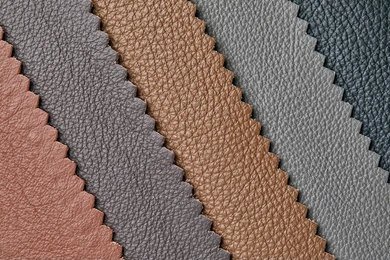
Quality faux leather shows a consistent, evenly embossed grain pattern with a smooth or lightly textured surface, depending on the finish. A well-made coating hides the base fabric completely, with no visible weave showing through the surface or at the edges.
Thickness and Weight
Faux leather thickness typically ranges from 0.5 mm (0.02 in) to 1.5 mm (0.06 in), depending on the base fabric weight and coating thickness. Heavier faux leather, used for upholstery and bags, weighs more per square metre than lighter versions used for garments and linings.
Flexibility and Softness
Quality faux leather bends and folds without stiff resistance, and it returns close to its original shape after folding. PU-coated faux leather generally feels softer and more flexible than PVC-coated faux leather, since PU forms a thinner, more pliable film.
Tensile Strength
Tensile strength measures how much pulling force faux leather withstands before it tears, recorded in Newtons per square millimetre (N/mm²) or pounds per square inch (psi). The base fabric controls most of this strength, since the coating itself adds little pulling resistance on its own.
Tear Resistance
Tear resistance measures how much force faux leather withstands once a cut or weak point starts to spread, recorded in Newtons (N). A tightly woven or knit base fabric gives faux leather higher tear resistance than a loose, low-density base.
Abrasion Resistance
Abrasion resistance measures how much surface rubbing faux leather withstands before the coating wears through, tested through thousands of cycles on a Martindale or Taber machine. A thicker, well-bonded coating resists abrasion longer than a thin or poorly cured coating.
Water Resistance
Faux leather resists water well, since its PU or PVC coating forms a closed, non-porous surface that stops liquid from soaking through. This property makes faux leather easy to wipe clean and suited to furniture, bags and footwear exposed to spills or rain.
Colour Fastness
Colour fastness measures how much colour transfers from faux leather onto a white cloth under rubbing, light exposure or perspiration, rated on a grey scale from 1 to 5. Pigments mixed directly into the coating resist fading better than a thin surface-printed colour layer.
Finish Adhesion
Finish adhesion measures how firmly the PU or PVC coating bonds to the base fabric, tested through a peel or cross-cut method. Weak finish adhesion causes peeling, bubbling or delamination within months of regular use.
Different Types of Faux Leather Fabric
There are 6 main types of faux leather fabric: PU leather, PVC leather, leatherette, synthetic leather, vegan leather and bio-based faux leather.
PU Leather
PU leather consists of a fabric base coated with polyurethane, which gives it a soft handfeel, good flexibility and a thinner profile than PVC leather. This type suits garments, bags and footwear that need a natural drape and lighter weight.
PVC Leather
PVC leather consists of a fabric base coated with polyvinyl chloride, which gives it a thicker, glossier and more water-resistant surface than PU leather. This type suits upholstery, outdoor products and industrial items that need higher water and stain resistance.
Leatherette
Leatherette refers to any faux leather made from a fabric base combined with a plastic coating, which covers both PU leather and PVC leather under one general term. Manufacturers and retailers use this term interchangeably with faux leather, synthetic leather and pleather.
Synthetic Leather
Synthetic leather refers to any man-made material built to copy real leather’s look and function, most often through a PU or PVC coating on a fabric base. This term covers PU leather, PVC leather and leatherette as broad categories within the same material family.
Vegan Leather
Vegan leather refers to any faux leather made without animal-derived ingredients, which includes standard PU and PVC leather along with newer plant-based versions. Brands use this term to highlight a cruelty-free material choice, regardless of whether the base plastic comes from petroleum or plants.
Bio-Based Faux Leather
Bio-based faux leather uses plant materials, such as vegetable oils, apple waste, cactus or mushroom fibre, to replace some or all of the petroleum-based plastic in a standard coating. This type costs more than PU or PVC leather and holds a small share of the market. It biodegrades faster and reduces reliance on fossil fuels.
PU Leather vs PVC Leather: What Is the Difference?
PU leather uses a thinner, softer polyurethane coating, while PVC leather uses a thicker, glossier polyvinyl chloride coating. PU leather bends more naturally, weighs less and breathes slightly better than PVC leather, which makes it common in garments and fashion bags. PVC leather resists water, stains and abrasion better than PU leather, which makes it common in upholstery, outdoor gear and industrial products. PU leather generally costs more to produce than PVC leather, since polyurethane formulation involves a more complex chemical process.
Faux Leather vs Real Leather
Faux leather differs from real leather across 7 factors: material source, appearance and feel, durability, breathability, water resistance, cost and environmental impact.
Material Source
Faux leather comes from a fabric base coated with PU or PVC plastic, while real leather comes from a tanned animal hide. This difference means faux leather production needs no animal hide, while real leather production depends entirely on the livestock and tanning industries.
Appearance and Feel
Faux leather shows a uniform, repeated grain pattern from embossing, while real leather shows an irregular, natural grain with marks unique to each hide. Faux leather feels cooler and more plastic-like to the touch, while real leather feels warmer and softer, with a fibrous structure underneath the surface.
Durability
Real leather lasts longer than faux leather under normal use. Its natural fibre structure resists cracking and tearing for 10 to 20 years or more with care. Faux leather typically lasts 2 to 5 years before its coating cracks, peels or delaminates from the base fabric.
Breathability
Real leather breathes well, since its natural fibre structure allows air and moisture to pass through it. Faux leather breathes poorly, since its plastic coating forms a closed, non-porous surface that traps heat and moisture against the skin.
Water Resistance
Faux leather resists water better than untreated real leather, since its PU or PVC coating forms a sealed surface that liquid can’t soak through. Real leather absorbs water unless it receives a separate waterproof treatment, which can darken its surface and affect its natural patina.
Cost
Faux leather costs less than real leather, with prices generally 50% to 80% lower for comparable products. This price gap comes from faux leather’s faster, less labour-intensive production process compared with hide sourcing, tanning and finishing.
Environmental Impact
Faux leather production avoids animal use, but its petroleum-based plastics don’t biodegrade and can persist in the environment for 200 to 500 years after disposal. Real leather biodegrades within 10 to 20 years, but its production depends on livestock farming and chemical-heavy tanning processes, which carry their own environmental costs.
How Is Faux Leather Fabric Used?
Faux leather fabric serves 6 main uses: footwear, bags and accessories, garments, furniture and upholstery, automotive interiors and industrial products.
Footwear
Manufacturers use faux leather for shoes, boots and sandals that need a leather-like surface at a lower cost and consistent supply. This material resists water and stains well, which suits everyday and outdoor footwear.
Bags and Accessories
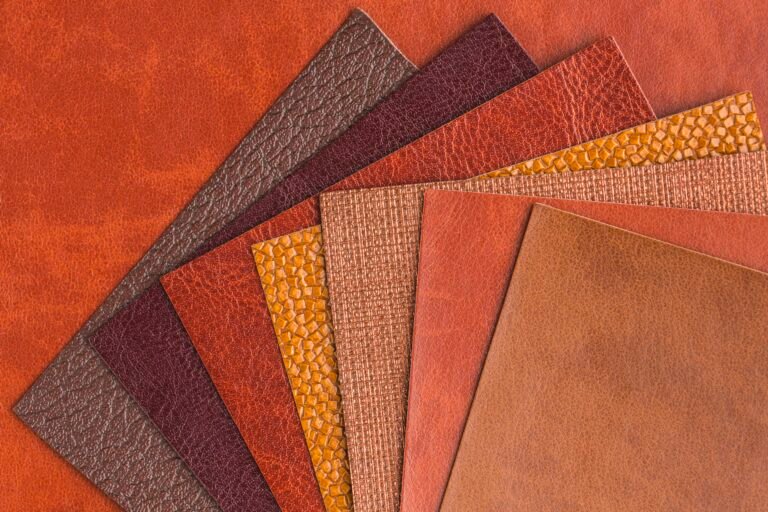
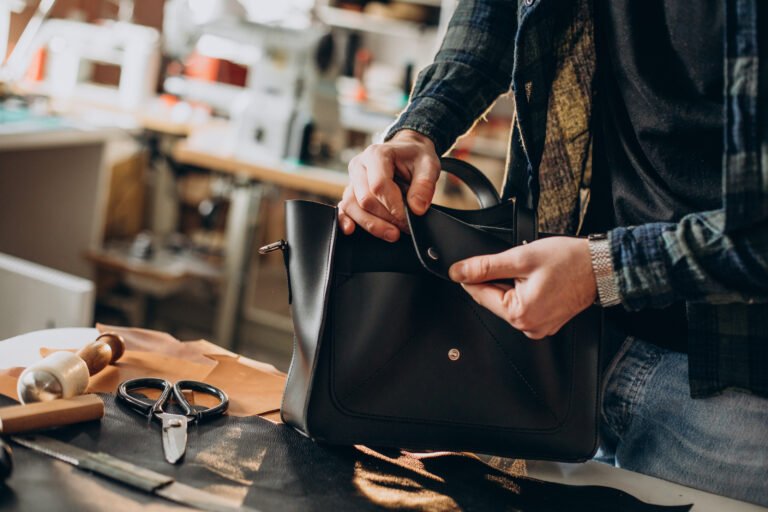
Manufacturers use faux leather for handbags, wallets, belts, watch bands and phone cases, since it holds colour and shape consistently across large production runs. This material allows brands to offer a wide range of colours not commonly available in real leather.
Garments
Manufacturers use faux leather for jackets, coats, pants and skirts, since PU-coated versions offer a soft drape close to real leather’s feel. This material insulates body heat well, which makes it a common choice for outerwear.
Furniture and Upholstery
Manufacturers use faux leather for sofas, chairs and headboards, since it resists stains, cleans easily and costs less than real leather upholstery. This material suits homes with children or pets, since it resists scratches and spills better than many fabric alternatives.
Automotive Interiors
Manufacturers use faux leather for car seats, dashboards and door panels, since it resists UV fading, spills and daily wear at a lower cost than real leather. This material lets automakers offer consistent colour matching across an entire vehicle interior.
Industrial Products
Manufacturers use faux leather for firearm holsters, luggage, sports equipment and protective gear, since it combines water resistance with consistent thickness and strength. This material holds up under repeated handling in commercial and outdoor settings.
Where Is Faux Leather Fabric Produced?
China produces and exports more faux leather than any other country, supplying manufacturers across Asia, Europe, North America and South America. Other producing countries include South Korea, Taiwan, Italy and the United States, which focus on smaller volumes of higher-end PU leather. Faux leather production concentrates in countries with strong textile and chemical manufacturing bases, since coating production needs fabric mills and plastic processing facilities close together.
How Much Does Faux Leather Fabric Cost?
Faux leather fabric costs $8 to $25 per yard (about $9 to $27 per metre), depending on the coating type, thickness and finish quality. PVC leather generally costs less than PU leather, since its raw materials and production process cost less overall. Bio-based faux leather costs more than standard PU or PVC leather, often 2 to 3 times as much. Smaller production volumes and pricier plant-based inputs drive this higher cost.
Common Faux Leather Fabric Defects
Faux leather fabric shows 8 common defects: cracking, peeling, delamination, colour fading, poor flex resistance, weak coating adhesion, uneven surface finish and chemical odour.
Cracking
Cracking appears as fine surface lines that widen over time, most often at fold points such as seat edges, jacket elbows or bag corners. This defect comes from a dry, aged coating or a formulation with too little plasticizer content.
Peeling
Peeling shows as the coating lifting away from the base fabric in sheets or flakes, usually starting at an edge or high-wear point. This defect comes from weak finish adhesion between the coating and the base fabric during production.
Delamination
Delamination happens when the coating separates completely from the base fabric, leaving a bare, fabric-only surface underneath. This defect comes from poor bonding during the coating stage, often from incorrect heat, pressure or curing time.
Colour Fading
Colour fading shows as a dulling or shifting of the original colour after exposure to sunlight, cleaning chemicals or repeated washing. This defect comes from low-grade pigments or a thin colour layer that sits on the surface instead of blending into the coating.
Poor Flex Resistance
Poor flex resistance shows as cracks forming after only a small number of fold or bend cycles, well below the expected lifespan of the material. This defect comes from a stiff or brittle coating formulation that lacks enough plasticizer for the intended use.
Weak Coating Adhesion
Weak coating adhesion shows as the surface lifting, bubbling or separating when pulled or scratched, even under light pressure. This defect comes from an under-cured bond, contamination on the base fabric, or a mismatched coating and fabric combination.
Uneven Surface Finish
Uneven surface finish shows as patches of different gloss, texture or colour depth across the same roll of faux leather. This defect comes from inconsistent coating thickness or uneven heat during the curing and embossing stages.
Chemical Odour
Chemical odour comes from leftover solvents, plasticizers or unreacted raw materials that didn’t fully cure during production. A strong, lasting chemical smell signals poor production control and often points to non-compliant chemical content.
How to Check Faux Leather Fabric Quality
Buyers and manufacturers can check faux leather fabric quality through 7 checks: visual inspection, thickness measurement, flexibility check, coating adhesion check, abrasion resistance check, colour fastness check and chemical safety check.
Visual Inspection
Visual inspection catches surface defects, such as uneven embossing, colour patches or visible fabric weave, within seconds under good light. Buyers should check a full roll at multiple points, not only the outer layer, since defects often appear only partway through a batch.
Thickness Measurement
Thickness measurement uses a dial or digital gauge to confirm faux leather stays within the required range across a full roll. Buyers should measure thickness at several points, since uneven coating application shows up as thickness variation from edge to edge.
Flexibility Check
Flexibility check involves folding a sample sharply and checking the crease for cracks, whitening or stiffness. Quality faux leather flexes smoothly and shows minimal marking at the fold point.
Coating Adhesion Check
Coating adhesion check involves pulling or scratching a sample’s surface to test how firmly the coating bonds to the base fabric. A coating that lifts, bubbles or peels under light pressure signals weak adhesion and a higher risk of early failure.
Abrasion Resistance Check
Abrasion resistance check involves rubbing a sample repeatedly against a rough surface and checking for wear or coating breakdown. Faux leather that shows fabric backing through the coating after light rubbing fails this check.
Colour Fastness Check
Colour fastness check involves rubbing a sample against a white cloth and checking for colour transfer. Faux leather with strong colour fastness leaves little to no colour on the cloth after repeated rubbing.
Chemical Safety Check
Chemical safety check involves lab testing for restricted substances, such as heavy metals, phthalates and Chromium VI, against buyer and regulatory limits. This check confirms faux leather safety for products that touch skin directly, such as garments and gloves.
Faux Leather Fabric Testing Methods
Laboratories run 12 core tests to evaluate faux leather fabric quality: tensile strength, tear strength, abrasion resistance, flex resistance, peel strength, thickness, colour fastness, water resistance, coating adhesion, chemical content, heavy metals and RSL compliance.
Tensile Strength Testing
Tensile strength testing pulls a faux leather sample apart at a controlled speed and records the force it withstands in Newtons per square millimetre (N/mm²) before it breaks. This test confirms whether the base fabric and coating combination meets the minimum strength needed for the intended product.
Tear Strength Testing
Tear strength testing measures the force needed to spread a small cut through a faux leather sample, recorded in Newtons (N). This test predicts how the material performs at stitch holes, corners and stress points on finished products.
Abrasion Resistance Testing
Abrasion resistance testing rubs a faux leather sample against a standard material for a set number of cycles on a Martindale or Taber machine, then checks the coating for wear. This test predicts how long the surface holds up under everyday friction.
Flex Resistance Testing
Flex resistance testing bends a faux leather sample repeatedly on a flexometer and counts the cycles before cracks appear in the coating. This test confirms whether the coating formulation stays flexible enough for its intended use.
Peel Strength Testing
Peel strength testing pulls the coating away from the base fabric at a set angle and speed, recording the force needed in Newtons per centimetre (N/cm). This test confirms how firmly the coating bonds to the fabric and predicts resistance to delamination.
Thickness Testing
Thickness testing uses a dial or digital gauge to measure faux leather in millimetres (mm) at multiple points across a sample. Consistent thickness confirms even coating application during production.
Colour Fastness Testing
Colour fastness testing checks how much colour transfers from faux leather onto a white cloth under rubbing, light exposure or perspiration, rated on a grey scale from 1 to 5. A higher rating confirms stable pigmentation that resists fading and transfer.
Water Resistance Testing
Water resistance testing exposes a faux leather sample to water under controlled pressure or time and checks for leakage through the coating. This test confirms performance for footwear, bags and outdoor products exposed to moisture.
Coating Adhesion Testing
Coating adhesion testing uses a cross-cut or tape-pull method to check how firmly the coating bonds to the base fabric. Weak results predict early peeling, bubbling or delamination in finished products.
Chemical Testing
Chemical testing screens faux leather for restricted substances, pH levels and formaldehyde content against buyer and regulatory limits. This test confirms material safety for products that touch skin directly.
Heavy Metal Testing
Heavy metal testing checks faux leather for lead, cadmium, mercury and arsenic content against restricted substance limits. This test confirms safety for children’s products, garments and accessories sold in regulated markets.
RSL Testing
Restricted Substances List (RSL) testing checks faux leather against a buyer’s or region’s full list of banned or limited chemicals, which often includes phthalates, azo dyes and heavy metals together. Exporters use RSL testing to confirm a shipment meets every requirement before it reaches a specific retailer or market.
Faux leather performance depends on the base fabric, the coating formulation and the finishing process. Common quality checks include abrasion resistance, flex resistance, peel strength and tear strength.
Faux Leather Fabric Standards and Compliance
Faux leather fabric compliance follows 5 main categories: ISO standards, ASTM standards, buyer-specific requirements, RSL compliance requirements and export quality requirements.
ISO Testing Standards
The International Organization for Standardization (ISO) publishes test methods for coated fabrics, covering thickness, tensile strength, tear strength, colour fastness and coating adhesion. Laboratories and manufacturers reference ISO standards to keep test results consistent across countries and buyers.
ASTM Testing Standards
The American Society for Testing and Materials (ASTM) publishes standards for coated fabrics and synthetic leather, covering physical properties, colour fastness and coating performance. Manufacturers and exporters use ASTM standards for products bound for markets across the Americas.
Buyer-Specific Testing Requirements
Large retailers and brands often set testing requirements above ISO and ASTM minimums, with specific limits for chemical content, peel strength or abrasion cycles. Exporters need a copy of each buyer’s testing manual before production, since requirements vary widely between retailers.
RSL Compliance Requirements
RSL compliance requirements list the exact chemicals, such as phthalates, heavy metals and azo dyes, that a faux leather shipment must stay under or avoid completely. Exporters test against the specific RSL version tied to their buyer or destination market, since limits change between regions and retailers.
Export Quality Requirements
Export quality requirements combine destination-country regulations, buyer specifications and RSL limits into one checklist before shipment. Exporters who confirm compliance before shipment avoid customs delays, shipment rejection and financial penalties.
Faux Leather Fabric Certifications
Faux leather fabric certification covers 5 main areas: OEKO-TEX certification, REACH compliance, RoHS compliance, vegan material claims and eco-friendly material claims.
OEKO-TEX Certification
OEKO-TEX certification confirms that a faux leather fabric’s components stay under set limits for harmful substances, including those relevant to direct skin contact. Brands use this certification to support safety claims for garments, bags and children’s products.
REACH Compliance
Registration, Evaluation, Authorisation and Restriction of Chemicals (REACH) compliance confirms that a faux leather fabric meets European Union limits for restricted and hazardous chemicals. Exporters need REACH compliance to sell faux leather products into European markets legally.
RoHS Compliance
Restriction of Hazardous Substances (RoHS) compliance confirms that hardware, fittings or components attached to faux leather products stay under set limits for lead, cadmium and other restricted metals. This compliance applies most often to faux leather goods with metal zips, buckles or studs.
Vegan Material Claims
Vegan material claims confirm that a faux leather product contains no animal-derived ingredients anywhere in its base fabric, coating or finish. Brands support these claims through supplier declarations and, in some cases, third-party vegan certification bodies.
Eco-Friendly Material Claims
Eco-friendly material claims cover attributes such as bio-based content, reduced solvent use or recycled base fabric in faux leather production. Brands should support these claims with test data or third-party verification, since eco-friendly claims without evidence draw regulatory and consumer scrutiny.
Environmental Impact of Faux Leather Fabric
Faux leather fabric affects the environment through 5 main factors: PU leather impact, PVC leather impact, chemical and plastic concerns, recycling and disposal challenges, and bio-based alternatives.
PU Leather Environmental Impact
PU leather production uses isocyanates and solvents that release volatile organic compounds (VOCs) during manufacturing. This material doesn’t biodegrade. Its production generally uses fewer harmful chemicals than PVC leather production.
PVC Leather Environmental Impact
PVC leather production releases dioxins and other toxic byproducts during manufacturing and disposal, which makes it one of the more environmentally damaging plastics in common use. This material relies on chlorine and petroleum as core inputs, both tied to separate environmental costs during extraction and processing.
Chemical and Plastic Concerns
Faux leather production and disposal release plasticizers, solvents and, in the case of PVC, chlorine-based compounds into the surrounding environment. These substances can affect soil, water and air quality near production sites and landfills.
Recycling and Disposal Challenges
Faux leather resists recycling, since its bonded fabric and plastic layers can’t separate easily through standard recycling processes. Discarded faux leather can persist in landfills for 200 to 500 years before it breaks down.
Bio-Based Alternatives
Bio-based alternatives replace some or all of the petroleum-based plastic in faux leather with plant materials, such as vegetable oils, apple waste, cactus or mushroom fibre. These materials biodegrade faster than standard PU or PVC leather. They still make up a small share of total faux leather production.
How Manufacturers Can Improve Faux Leather Quality
Manufacturers can improve faux leather quality by controlling coating thickness, curing temperature and base fabric consistency at every production stage. Regular in-line thickness and adhesion checks catch defects before a full roll reaches the cutting stage.
Manufacturers who source consistent, quality-tested base fabric and run batch-level lab testing on coating formulations reduce cracking, peeling and colour fastness issues in finished products. Working with a third-party lab for periodic testing helps manufacturers catch formulation drift before it affects a full production run.
Why Laboratory Testing Is Important for Faux Leather Fabric
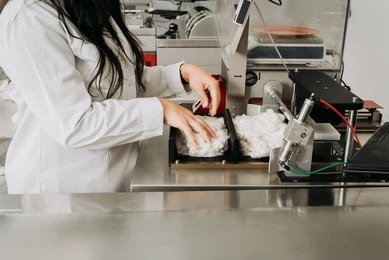
Laboratory testing confirms faux leather fabric performance and safety with exact figures, not visual impressions or supplier claims. Faux leather performance depends on the base fabric, the coating formulation and the finishing process, and only lab testing measures how these factors hold up under tensile, tear, abrasion and flex stress.
Chemical testing confirms that a batch stays under restricted substance limits, which protects both end users and export shipments from compliance failures. Manufacturers, exporters and brands who skip lab testing risk product returns, shipment rejection and safety complaints after goods reach the market.
Faux Leather Fabric Testing in Pakistan
Faux leather fabric testing in Pakistan supports manufacturers, exporters and brands across Karachi, Lahore and other production centres.
Faux Leather Testing in Karachi
Karachi hosts a large share of Pakistan’s textile and synthetic leather manufacturers, and this creates constant demand for lab testing on-site or nearby. Manufacturers in Karachi need fast turnaround on tests such as tensile strength, coating adhesion and chemical content to meet export shipment deadlines.
Faux Leather Testing in Lahore
Lahore houses a large number of garment, footwear and accessory manufacturers that use faux leather fabric in their products. Brands in Lahore use lab testing to confirm quality before bulk production and before shipment to international buyers.
Faux Leather Testing for Manufacturers, Exporters and Brands
Manufacturers use faux leather testing to confirm raw material quality before production starts. Exporters use this testing to confirm shipment compliance with buyer and destination-market requirements. Brands use testing reports to verify supplier claims and back up their own quality and safety statements to customers.
How SAB Labs Helps with Faux Leather Fabric Testing
SAB Labs helps manufacturers, exporters and brands test faux leather fabric through physical, mechanical, chemical, heavy metal and RSL compliance testing under ISO and ASTM standards.
The lab checks thickness, tensile strength, tear strength, abrasion resistance and flex resistance to confirm product durability. It also tests restricted chemicals, heavy metals and formaldehyde to verify material safety for skin-contact products and regulated export markets.
SAB Labs supports pre-production batch testing, pre-shipment compliance testing and third-party verification reports for clients across Karachi, Lahore and other cities in Pakistan.
Final Thoughts on Faux Leather Fabric Quality and Testing
Faux leather fabric quality depends on the base fabric, the PU or PVC coating formulation and the finishing process applied during manufacturing. PU leather and PVC leather each suit different products, based on the balance of softness, water resistance and cost that a manufacturer needs. Manufacturers, exporters and brands who pair physical checks with ISO and ASTM lab testing catch defects such as cracking, peeling and weak coating adhesion before they reach a shipment or a customer.
SAB Labs supports this process through faux leather fabric testing in Karachi, Lahore and across Pakistan, covering physical, mechanical, chemical, RSL and heavy metal testing for every stage of production and export.
FAQs About Faux Leather Fabric
What is faux leather fabric?
Faux leather fabric is a synthetic material made from a fabric base coated with polyurethane (PU) or polyvinyl chloride (PVC) to copy the look and feel of real leather. People also call it pleather, synthetic leather, vegan leather or artificial leather.
Is faux leather real leather?
No, faux leather is not real leather. Faux leather contains no animal hide and consists entirely of a fabric base and a plastic coating, while real leather comes from a tanned animal hide.
What is faux leather made of?
Faux leather is made of a base fabric, most often cotton or polyester, coated with polyurethane or PVC, plus pigments and finishing chemicals. Bio-based versions replace some of this plastic with plant materials, such as vegetable oils or fruit waste.
What is the difference between PU leather and PVC leather?
PU leather uses a thinner, softer polyurethane coating, while PVC leather uses a thicker, glossier polyvinyl chloride coating. PU leather bends more naturally and weighs less, while PVC leather resists water and abrasion better.
Is faux leather waterproof?
Yes, faux leather resists water well, since its PU or PVC coating forms a closed, non-porous surface. This makes it easy to wipe clean and resistant to spills and light rain.
Is faux leather durable?
Faux leather offers moderate durability, typically lasting 2 to 5 years before its coating cracks, peels or delaminates. Real leather lasts longer under normal use, often 10 to 20 years or more with care.
Why does faux leather peel or crack?
Faux leather peels or cracks from weak coating adhesion, an aged or dried-out coating, or a low-plasticizer formulation that turns brittle over time. Heat, repeated folding and sunlight exposure speed up this damage.
How can you check faux leather quality?
Buyers can check faux leather quality through visual inspection, thickness measurement, a flexibility check and a coating adhesion check. Lab testing adds abrasion, colour fastness and chemical safety results on top of these checks.
Which tests are used for faux leather fabric?
Common tests for faux leather fabric include tensile strength, tear strength, abrasion resistance, flex resistance, peel strength, colour fastness, water resistance, chemical content, heavy metals and RSL compliance.
Where can I get faux leather fabric testing in Pakistan?
SAB Labs provides faux leather fabric testing in Karachi, Lahore and other cities across Pakistan, covering physical, mechanical, chemical, RSL and heavy metal testing for manufacturers, exporters and brands.